Why a Small Project Can Hold an Afternoon
A small project can give an afternoon a satisfying shape: choose a clear endpoint, gather suitable materials and know when to stop or pause.
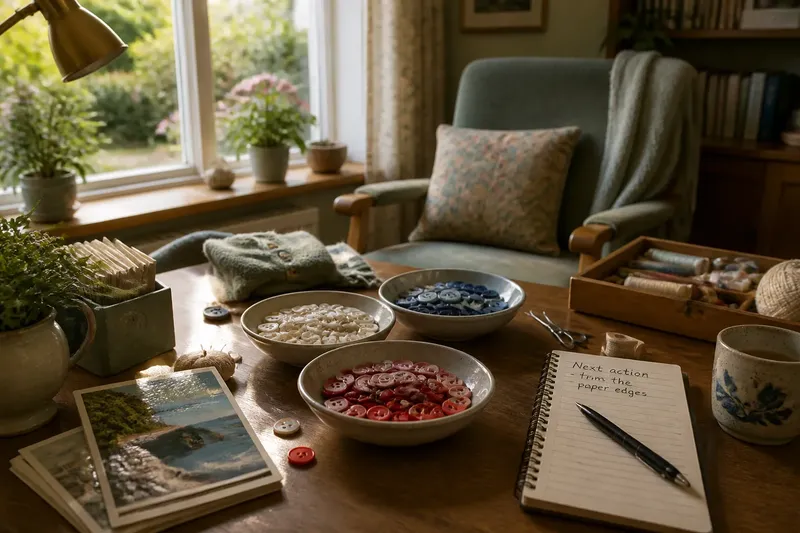
A small project can give an unhurried afternoon a satisfying shape without turning free time into an assignment. Choose something with a visible endpoint, such as sorting a tin of buttons by colour or preparing a few plant labels, and the hours have a natural arc: begin, make progress, then stop when the task is complete or no longer inviting.
The useful scale is not defined by how impressive the result looks. It is defined by whether you can tell what “done for now” means. That boundary leaves room for concentration while making it easier to set the work aside without feeling that the afternoon has slipped away unfinished.
Choose a visible endpoint
Before you begin, describe the finish in a sentence. “Sort these postcards into three piles” is clearer than “work on my postcards”. “Mend the loose button on this cardigan” has a natural limit; “repair my wardrobe” does not.
A good endpoint can be seen, counted in ordinary terms, or confirmed by a simple decision. It might be a small object ready to use, a short list of choices made, or a specific patch of a larger hobby brought to a stopping point. Avoid making the result depend on perfection. “Arrange the shells I already have in this shallow bowl” is more manageable than “make the display look just right”.
If the project belongs to a larger interest, define a self-contained portion. A knitting project might be limited to choosing a pattern and winding one ball of yarn, rather than finishing a whole garment. A gardening afternoon might mean filling and labelling one seed tray, not reorganising every pot and tool.
Shape the afternoon
A loose routine offers enough structure to get started without dictating every minute. Let the project fit the afternoon you actually have: your energy, the light in the room, the space available and any plans that follow. The sequence below is a guide, not a timetable.
- Before starting: Pick one project and state its endpoint. If the finish still sounds vague, narrow the task until it can be described plainly.
- At the beginning: Gather only the materials and tools needed for that portion. Put them on a tray, table or clear patch of worktop, and make the first action easy to see.
- As you work: Continue while the task holds your attention. If you pause, leave a note about the next small action, such as “trim the paper edges” or “choose the label wording”.
- When the endpoint arrives: Look at what is finished and decide whether the afternoon’s project is complete. Do not add a new task simply because the first one went smoothly.
- Before putting materials away: Leave the project in a state that is easy to resume or safely store. Clear the surface enough for ordinary use, then choose whether you want another activity or a quieter end to the afternoon.
That plan has a deliberate stopping point, but it is not a promise to keep working until then. If your attention fades, a planned pause can help you decide whether to return. If you are enjoying the work and have time, you can continue within the same boundary rather than allowing the project to expand.
Prepare a gentle start
Starting often takes more effort than the hands-on task. Materials spread across several cupboards, a missing tool, or an unclear first move can make a small idea feel like a large undertaking. Reduce that friction before the afternoon begins, or choose a project whose supplies are already together.
Keep the first action concrete: open the sketchbook to a blank page, place the loose buttons in a dish, or put the seed packets beside the labels. A project can also benefit from a simple “ready to begin” container. A shallow box for mending might hold thread, needles, scissors and the one garment selected for that session; it need not become a permanent craft station.
Choose a comfortable setting for the work. Good light helps with close detail; a stable chair and a clear surface make it easier to settle. If a task calls for materials with handling or care instructions, follow the label or maker’s guidance. For ordinary projects, the main test is whether the setup lets you begin without a separate round of preparation becoming the afternoon’s real task.
Keep the scope modest
A project grows when each finished action creates another obligation. Sorting buttons can turn into sewing them on garments; arranging a few recipe cards can become a kitchen-wide reorganisation. Those related ideas may be worthwhile, but they are separate projects. Write them on a note for another day rather than folding them into the current one.
Say you have a small box of postcards and an afternoon free. You decide to make three piles—places, family and unlabelled—and set aside any cards that do not fit without trying to identify every image. Once the piles are made, you can see the endpoint and stop; if you still feel curious, a note reading “look up the unlabelled cards another day” preserves the idea without extending this project.
That kind of boundary is particularly useful when a task has no obvious finish by itself. Choose a portion by location, object or decision: one drawer, one recipe, one plant pot, or one set of materials. The smaller boundary makes progress visible and prevents a pleasant pastime from acquiring the pressure of a household overhaul.
Notice when to stop
A project has run its course when the endpoint is reached, but completion is not the only reason to stop. You might notice that you are repeating the same choice, handling materials without making a decision, or thinking more about the next chore than the task in front of you. Those are useful cues to pause, not signs that the afternoon has failed.
At a pause, ask a plain question: would I like to return to this, or would another kind of rest suit me better? If you want to resume, leave the next action visible and put delicate or loose materials somewhere they will not be disturbed. If you do not, make a small note of what remains and close the project for now.
Do not create extra work in the name of a tidy finish. A project may be complete even if the result is simple or a few materials need to be put away later. The useful closing action is one that makes the space comfortable and the next choice clear, not one that turns leisure into a second round of chores.
Questions about small projects?
What makes a project small enough?
It has a clear endpoint and can be started with the time, attention and materials you have available. If the task contains several unrelated decisions, choose one portion and leave the rest for another session.
What if I do not finish?
Decide whether the work is worth resuming, then write down the next action in plain words. A useful stopping point can be a clear note and safely stored materials rather than a completed object.
Should I keep working if I feel interested?
You can continue if you have time and still feel comfortable, but keep the original endpoint in view. If the next task is a different project, note it separately so that one satisfying afternoon does not become an open-ended list.
What if I cannot choose a project?
Look for a modest task already waiting nearby: mend one loose seam, arrange a few cut flowers, or sort one small bundle of papers. Choose the option with the clearest first action and easiest stopping point.
Leave room afterwards
A small project works best when the rest of the afternoon is not treated as an empty space that must be filled. Once the task is done—or you have chosen to stop—there is room for tea, a phone call, a short walk, or simply sitting down. The project has offered a shape, not a demand to account for every hour.
For a small project to hold an afternoon, make the finish clear before beginning and allow yourself to revise the plan as the day unfolds. A note, a tray of materials or a completed corner of a larger hobby can be enough. The most useful result may be a finished task, or the quiet confidence of knowing exactly where you would pick it up again.